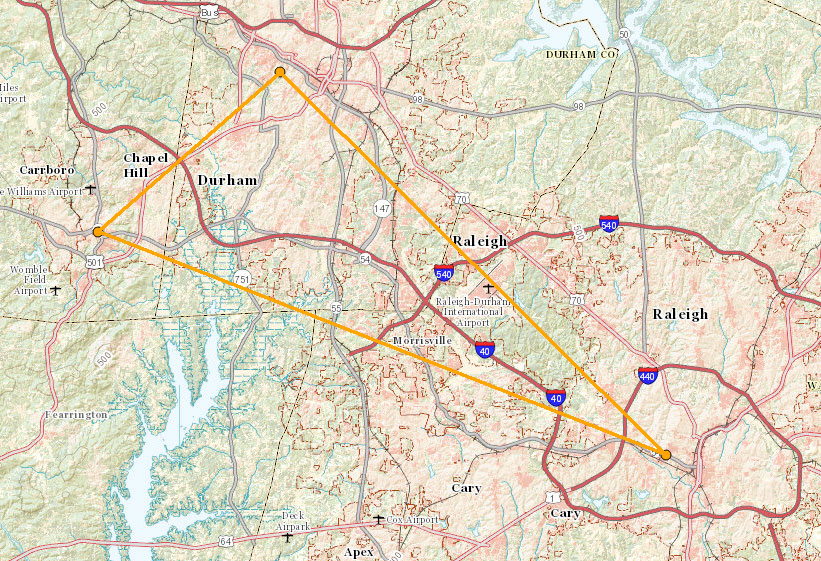
A map of the Research Triangle, North Carolina, featuring the locations of North Carolina State University, Duke University, and University of North Carolina at Chapel Hill. South Asian American communities have flourished in the Research Triangle, as well as other cities like Morrisville and Charlotte.
Credit: United States Geological Survey via Wikimedia Commons
Grade: 6-9Subject:
U.S. History, Social Studies, English Language Arts
Number of Lessons/Activities: 5
Since 1965, the Indian American community in North Carolina has grown significantly. This was enabled by the Immigration and Nationality Act of 1965, which favored family reunification and immigrants with specific skills that met U.S. labor needs. South Asian communities flourished in the Research Triangle—Durham, Raleigh, and Chapel Hill—as well as Morrisville and Charlotte. In this lesson, students will learn about the multiple factors that led to the growth of the Indian American community in North Carolina. More specifically, they will examine the history, challenges, and resistance efforts of Indian hotel owners in North Carolina. Students will also analyze oral histories to learn more about this community.
Students will:
- Explain the multiple causes and effects of the growth of the Indian American community in North Carolina.
- Examine the challenges faced by Indian hotel owners.
- Examine the resistance efforts of Indian hotel owners.
- Analyze oral histories of South Asian Americans in North Carolina.
Indian Americans in North Carolina Essay:
South Asian immigration to the eastern United States began as early as the 1600s. The first account appears in 1635, with colonial records from Virginia mentioning a “Tony - East Indian” living under British rule. His story, however, remains a mystery. Like other East Indians mentioned in early documents, we do not know whether he lived as a free man, an
indentured servant, or a slave. Still, the earliest population of South Asians in the United States was most likely very small.
It wasn’t until the 19th and 20th centuries that the South Asian population grew more visible. In the early 1900s,
Sikh laborers from Punjab in northern India sought better opportunities abroad. Many found work on the West Coast, harvesting crops in California’s fields or cutting timber in the forests of Washington and Oregon. But opportunity came with hardship. Anti-immigrant hostility was spreading across the country. South Asians quickly became targets. In 1917, Congress passed the Immigration Act that established the “
Asiatic Barred Zone,” banning most migrants from Asia.
Immigration from Asian countries remained limited until 1965, when President Lyndon B. Johnson (1908-1973) signed the Immigration and Nationality Act. Before this, strict
quotas limited the number of people who could migrate to the United States based on their country of origin. The 1965 Immigration Act dismantled this discriminatory system and opened up migration from Asia after decades of exclusion. At the same time, this new system also favored immigrants who had specific skills and met the labor needs of the United States. After immigration reforms in the 1970s, waves of doctors, engineers, and other highly trained professionals from Asia began arriving in the United States.
Many South Asians found their way to North Carolina. They were drawn there by jobs in the Research Triangle—Durham, Raleigh, and Chapel Hill—where three major universities fueled a booming medical and tech economy. What began as a small trickle soon became a steady stream of immigrants. The region’s Asian population has been growing ever since.
Communities have also flourished beyond the Triangle, in places like Morrisville and Charlotte. There, international grocery stores,
Hindu temples, and Indian restaurants anchor cultural life. In 2011, Steve Rao (born 1971) became the first Indian American elected official, serving on the Morrisville Town Council in Wake County. Reflecting on the town’s transformation, Rao remarked in a 2023 interview, “I can start my day with a South Indian breakfast…and I can end my day with a
Bollywood performance at the Hindu Society of North Carolina.”
This rapid growth was fueled in part by what sociologists call “chain migration.”
1 A few South Asian families would settle in an area, establish businesses, cultural institutions, and/or enter specific industries. Soon, word spread. Because the 1965 Immigration Act also favored family reunification,
1 these families would
sponsor their relatives to immigrate to the United States. Soon, more South Asians were drawn to the same neighborhoods, strengthening both professional networks and community life across North Carolina.
Chain migration helps explain why many South Asian families own hotels and motels across the South and Midwest United States. Indians make up less than 1% of the U.S. population, but they own about 50% of the nation’s hotels and motels, particularly in the lower-to-middle budget bracket. And most of these owners are not just Indian, but share the surname “Patel.” In India’s
caste system, Patels belong to the Vaishya caste, traditionally merchants and traders. A caste system is a social
hierarchy that divides society into ranked groups based on people’s birth. People’s caste status determines all parts of their life, including who they can marry, where they live, and what jobs they can have. India’s caste system has existed for at least 3,000 years. It was made illegal in 1950, but enduring discrimination and unjust power dynamics continue to exist. When Indians move to other countries, sometimes the norms, privileges, and burdens of their caste status impacts their migration and settlement experience. It perhaps makes sense that Indians who came from a caste of businesspeople would go on to start businesses when they move to the United States. The first immigrants to enter the business would pool their resources to buy motels. Then, they would help their relatives enter the hospitality industry. They would sponsor them to the United States, give them jobs, and share their knowledge about the business. Because of their shared identity and extended networks, this community gradually occupied a large sector of the hotel/motel industry.
The first Patel hoteliers started their business in the 1940s and 1950s in California, but the growth of Indians in the hotel industry largely happened in cities in the U.S. South. During the 1970s, cities like Atlanta in Georgia, Dallas in Texas, and Chapel Hill, Raleigh, and Durham in North Carolina, were in economic transition as farms, factories and textile mills closed. As a result, some industries, including the hotel and motel industry, were more affordable for immigrants to enter into compared to in the West Coast and Northeast. States like North Carolina, Texas, and Georgia saw an influx of Indian Americans purchasing abandoned or struggling motels. Yet success was not immediate. Guests refused bookings once they realized the racial identity of the motel owners.
Insurance companies often refused coverage. Major hotel chains blocked Indian immigrants from acquiring
franchises. In response, Indian hoteliers organized to demand fair contracts, insurance access, and property rights.
One of the earliest examples of Indian American hotel owners having to fight for their
entrepreneurial rights in North Carolina was Harish “Harry” Pattni,
2 a former bellhop from California who moved to Rockingham, North Carolina. In 1981, Pattni purchased the Baker Motel in nearby Cheraw, South Carolina, and drew a largely African American clientele. While he welcomed their business, the previous White owners objected to Black customers occupying what had once been a Whites-only establishment. Masking their prejudice, they attempted to
foreclose on Pattni, alleging contract violations. Pattni fought back, and the courts sided with him, affirming his right to renovate and operate freely. His case illustrates how Indian American hoteliers in the U.S. South often navigated unspoken racial codes while asserting property rights in a tense social climate.
As more Indian American hoteliers mobilized against prejudice, some leaders in the industry like Ravi Patel2 and H.P. Rama2 founded the Asian American Hotel Owners Association (AAHOA) in 1989. The group initially met in Charlotte, North Carolina, and eventually became a national organization. The AAHOA has influenced national policy, including the 1999 Small Business Franchise Act3 which aimed to prevent fraud and exploitation to protect small businesses. Notably, the AAHOA focuses on business rights rather than civil rights and racial justice.
North Carolina continues to grow more diverse, with rapidly expanding Asian and South Asian populations. While earlier immigration patterns favored Hindus from particular castes, today’s communities also include Muslims, Christians, Pakistanis, and Sri Lankans. At the same time, second- and third-generation Indian Americans are navigating identity and finding belonging in the South while staying connected to their cultures through food, language, and the arts. Khanna Koneru’s (born 1983) story is one example. When Koneru moved to North Carolina as a child in the 1980s, she often felt out of place. There were few other Brown students in her schools, and she struggled to make sense of her identity. But as the state’s population changed and she met more Asian and South Asian peers in college, she began to see her own experiences reflected in others – those learning how to navigate the “in-betweens” of being both American and South Asian. That search for belonging eventually led her to co-found the organization, North Carolina Asian Americans Together (NCAAT), which builds power and community across the state. Today, the place that once made her feel different is also where she feels at home, and she is comfortable calling herself a Southerner.
1 The terms “chain migration” and “family reunification” are used to refer to family based immigration. U.S. immigration policy allows people seeking to live in the United States to be sponsored by a relative who is a U.S. citizen or U.S. Lawful Permanent Resident (green-card holder). In mainstream discourse, “chain migration” often has a negative connotation and is used by those who oppose immigration to suggest that immigration policy allows unlimited numbers of immigrants to freely enter the country. “Family reunification” is preferred by immigration advocates to reflect the visa system that allows people to apply for a visa through sponsorship by a relative.
2 Years of life unknown
3 The 1999 Small Business Franchise Act did not pass Congress, but the Federal Trade Commission’s (FTC) Franchise Rule addresses many of its goals.
Bibliography:
Dhingra, Pawan. Life Behind the Lobby: Indian American Motel Owners and the American Dream. Stanford, CA: Stanford University Press, 2012.
Hinnershitz, Stephanie. “Getting Down to Business in Dixie: Indian American Hotel Owners and Entrepreneurial Rights,” in A Different Shade of Justice: Asian American Civil Rights in the South, edited by Raymond A. Mohl et al. University of North Carolina Press, 2017.
Melomo, Vincent H. “Immigrant Dreams and Second-Generation Realities: Indian Americans Negotiating Marriage, Culture, and Identity in North Carolina,” Far East, Down South: Asians in the American South. Ed. Raymond A. Mohl, et al. University of Alabama Press, 2021.
- Asiatic: outdated term for Asian; this term is considered offensive, especially as associated with the policies of colonialism
- Bollywood: the movie industry in India
- Caste: a division of society based on differences of wealth, inherited rank or privilege, profession, occupation, or race
- Entrepreneurial: having to do with the creation and development of economic or business ventures
- Foreclose: to take legal measures to end a mortgage and take possession of the mortgaged property because the conditions of the mortgage have not been met
- Franchise: the right to sell a company's goods or services in a particular territory
- Hierarchy: persons or things arranged in ranks or classes
- Hindu: an adherent of Hinduism, the dominant religion of India that emphasizes dharma with its resulting ritual and social observances and often mystical contemplation and ascetic practices
- Indentured servant: a person who signs and is bound by indentures (contracts) to work for another for a specified time especially in return for payment of travel expenses and maintenance
- Insurance: a contract by which someone guarantees for a fee to pay someone else for the value of property if it is lost or damaged (as through theft or fire), or to pay usually a specified amount for injury or death
- Quota: a fixed number or percentage of a group
- Sikh: an adherent of Sikhism, a monotheistic religion of India founded about 1500 by Guru Nānak and marked by rejection of idolatry and caste
- Sponsor: a person who assumes responsibility for some other person, such as an immigrant
- What factors led to South Asian migration to the United States in the 1900s?
- Why was Asian immigration limited until 1965?
- What was the Immigration and Nationality Act of 1965? How did it impact South Asians?
- What factors contributed to the growth of the South Asian community in North Carolina?
- What is chain migration? How did this process impact the South Asian community in North Carolina?
- What factors led to the growth of Indian-owned hotels and motels in the U.S. South?
- What challenges did Indian hotel owners face in North Carolina? How have they fought back?
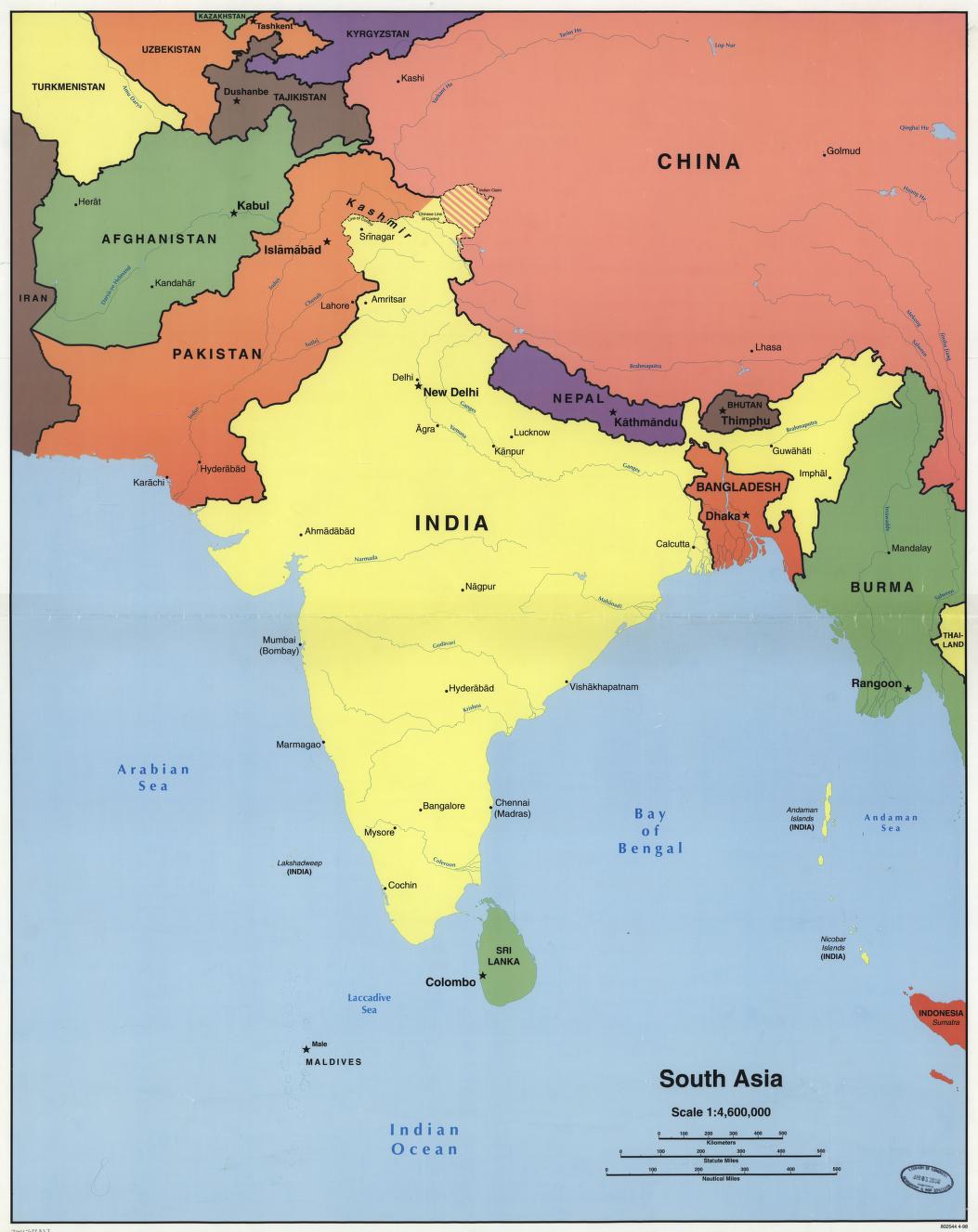
Map of South Asia
Credit: Library of Congress, Geography and Map Division
Activity 1: Observing Data on Asian Americans in North Carolina
- Have students work in small groups to explore the website entitled, “AANHPI Community Data Explorer” by AAPI Data. Give students a set amount of time (5-10 minutes) to examine data about Asian American communities in North Carolina.
-
Have each group share one interesting finding they found in their data exploration.
- Show students the graph entitled, “Population in North Carolina,” generated using the AANHPI Community Data Explorer. Ask students to make observations about the graph.
- Tell students the following: “The term ‘Asian Indian’ was created by the U.S. Census Bureau in the 1980s to refer to the Indian American community. This term was created to distinguish them from Indigenous peoples, who are often called ‘American Indians,’ or ‘Indians’ due to Christopher Columbus mistakenly believing he was in South Asia when he arrived in the Americas. Indian Americans may have different feelings toward the term ‘Asian Indian.’ Some prefer Indian American, South Asian, or others. We should always defer to individuals and communities when it comes to how they choose to identify.”
- Allow students to respond or ask any clarifying questions.
- Give space for Indian American and/or South Asian American students to share their perspective, but take care to not put them on the spot or expect them to be the “spokesperson” for their community.
- Tell students the following: “As the graph shows, Indian Americans are the largest Asian group in North Carolina. In this lesson, we will examine the history of the Indian American community in North Carolina.”
Activity 2: Explaining Multiple Causes and Effects of the Growth of the Indian American Community in North Carolina
- Have students read the essay. Consider the following options:
- OPTION 1: Have students read the essay independently either for homework or during class time.
- OPTION 2: Read aloud the essay and model annotating.
- OPTION 3: Have students read aloud in pairs or small groups.
- Facilitate a class discussion by asking students the Discussion Questions.
- Distribute the worksheet entitled, “Historical Causation.” Have students use the lesson essay to complete the worksheet. Have students add additional boxes if needed.
- Have students list causes for the growth of the Indian American community in North Carolina in the boxes on the top half of the page.
Have students list effects of the growth of the Indian American community in North Carolina in the boxes on the bottom half of the page.
Have students mark each box to categorize the cause/effect as one or more of the following:
- E - Economic (related to the production, distribution, and consumption of goods and services)
- P - Political (related to systems of power, government, or public affairs)
- C - Cultural (related to the ideas, customs, and social behavior of a society)
- S - Social (related to society, its organization, and how people interact or relate to each other)
- Have students mark each box to categorize the cause/effect as short, medium or long-term.
- ST - short-term
- MT - medium-term
- LT - long-term
Have students write a paragraph in response to the prompt: “What is the most significant cause of the growth of the Indian American community in North Carolina?” Have students support their argument with evidence from the lesson essay, or additional internet research as needed.

Indian Americans own about 50% of the nation’s hotels and motels, particularly in the lower-to-middle budget bracket.
Credit: Matthew Smith whale, CC0, via Wikimedia Commons /
Unsplash
Activity 3: Examining Challenges and Resistance of Indian Hotel Owners in North Carolina
- Distribute the worksheet entitled, “Challenges and Resistance of Indian Hotel Owners in North Carolina.”
- Have students complete the worksheet using the lesson essay by writing challenges Indian hotel owners faced in the left column.
- Have students write ways the hotel owners have responded to or resisted the challenges in the middle column.
- Have students explain the significance of these challenges and forms of resistance in the right column.
- Have students watch the video entitled, “Why Do Indian-Americans Own So Many Hotels” (AJ+).
- Have students add to the worksheet using the information learned in the video.
- Have students read the article entitled, “Tactics Used to Promote Civic Participation and Action in APIDA Communities.” Create the following table and display for all to see. Have students complete the table by referencing the article:
- Facilitate a discussion by asking the following questions:
- What are some of the issues underlying the challenges faced by Indian hotel owners? (For example, one challenge is that guests refused bookings once they realized the racial identity of the motel owners. An underlying issue is racism and White supremacy.)
- What tactics did Indian hotel owners use to respond to these challenges? How are these tactics similar or different from other forms of resistance you have learned about in other communities or other historical examples?
Activity 4: Analyzing Oral Histories of South Asian Americans in North Carolina
- Tell students that an oral history is a type of primary source in which firsthand accounts of history are preserved by recording personal recollections of history, usually through interviews. Facilitate a discussion by asking students the following questions:
- Why do you think oral history is important?
- How can oral history methodology help historians learn about the past?
- What are other ways historians can learn about the past?
- What are potential shortcomings of oral histories?
- What might you be able to learn from listening to oral histories recorded by South Asian Americans in North Carolina?
- Distribute the worksheet entitled, “Oral History Analysis: South Asian Americans in North Carolina.” Have students read the questions on the worksheet. Ask if they have any questions and clarify any misunderstandings.
- Have students access the website entitled, “Oral Histories” by Southern Mix at the University of North Carolina at Chapel Hill. Have students work in pairs to choose an oral history by using the filter dropdown list. (South Asian ethnicities include: Hindu, Hindu Punjabi, Indian, Indian American, Sikh, South Asian, Telugu.)
- Confirm student pairs have selected an oral history. Have them read the oral history interview excerpts, view the photos, and listen to the audio clips. (Note that the recording in its entirety and a transcript is available at the bottom of the page. Students are not required to listen to or read the entire interview, but might use these resources to extract quotes, etc.)
- Have students complete the worksheet:
- Have students complete the “Observing” section:
- Modality: What is the modality of the oral history (i.e., audio, video, written transcript, written document, etc.)?
- Interviewer: Who conducted this oral history?
- Interviewee: Who was interviewed in this oral history? What is their relationship to the interviewer?
- Background information of the interviewee: Where are they from? What places have they lived? Where is their family from? What schools have they attended? What occupations have they had?
- Have students respond to the following questions in the “Analyzing” section:
- What are the interviewee’s main claims?
- How does the interviewee grapple with their identity?
- What are the limitations of this oral history?
- Have students respond to the following questions in the “Reflecting” section:
- What did you learn from this oral history?
- What was the emotional impact of this oral history?
- What other questions would you like to ask?
- Have students respond to the following questions in the “Using as historical evidence” section:
- Think about the events and histories described in the oral history.
- How does the oral history affirm what you have learned about South Asian Americans in North Carolina?
- How does this oral history add to what you have learned about South Asian Americans in North Carolina?
- Are there any inconsistencies? If so, what might account for the inconsistencies?
- Why is this oral history important?
- How does this oral history shape your understanding of the South Asian American community in North Carolina?
- Have students form new small groups consisting of students who analyzed different oral histories. Have each student present a summary of the oral history they listened to, using the worksheet as a guide.
- Have students work together to identify recurring themes and common experiences across the oral histories.
- Have students identify differences across the oral histories they listened to and discuss what might account for these differences.
- Reconvene as a whole group. Facilitate a discussion by asking the following questions:
- How did the interviewees grapple with identities as South Asians? As Americans? As Southerners? As North Carolinians?
- What were the interviewee’s experiences with racism and/or discrimination? How was this shaped by their identities as South Asian?
- What did you learn from listening to oral histories recorded by South Asian Americans in North Carolina?
- What role does oral history play compared to other ways of learning about the past?

Sri Venkateswara Temple of North Carolina is a Hindu Temple located in Cary, North Carolina.
Activity 5: Summarizing the Contributions of Indian Americans in North Carolina
- Have students write an essay in response to the following prompt: “How have Indian Americans and/or South Asian Americans contributed to the development of North Carolina?” Have students cite evidence from the sources examined in this lesson, including the essay and oral histories.
- Tell students the following: “It is important to recognize the contributions of various groups, particularly marginalized communities, whose contributions are often ignored or unacknowledged. However, it is also important to note that people are not defined by their contributions, and all humans deserve dignity and respect regardless of their contributions.”
- Have students use the worksheet entitled, “Essay Planner” to organize their essays.
- Have students write an introduction in the top box.
- Have students list three contributions in the middle boxes.
- Have students list evidence for each contribution below the contribution.
- Have students write a conclusion in the bottom box.
- Have students learn more about South Asian American community organizations in North Carolina, such as North Carolina Asian Americans Together (NCAAT). Have students create a profile of the organization, including its history, goals, and programs. Encourage students to create a poster or promo video for the organization.
- Have students reflect on the oral histories they read and/or listened to in the lesson. Have students conduct an oral history interview to learn more about their own identities and experiences.
- Have students explore the Asian American Hotel Owners Association (AAHOA) website to learn more about the organization. Have students review the infographic on AAHOA Ownership & Economic Impact in North Carolina. Ask students, “What is the purpose of this infographic? Who is this information useful for?”
I.1.3
Analyze details, central ideas, and inferences from sources using discipline-specific strategies.
I.1.4
Assess the credibility of primary and secondary sources using the origin, authority, structure, credibility, reliability, and context of the sources to guide the selection
8.B.1.1
Determine how the relationship between different regional, social, ethnic, and racial groups have contributed to the development of North Carolina and the nation.
8.H.1.4
Explain how recovery, resistance, and resilience to inequities, injustices, discrimination, prejudice, and bias have shaped the history of North Carolina and the nation.
8.H.2.3
Explain how the experiences and achievements of women, minorities, indigenous, and marginalized groups have contributed to the development of North Carolina and the nation over time.
D2.His.14.6-8.
Explain multiple causes and effects of events and developments in the past.
D2.His.15.6-8.
Evaluate the relative influence of various causes of events and developments in the past.