Grade: 7-12Subject:
U.S. History, Social Studies, English Language Arts Number of Lessons/Activities: 8
Overview:
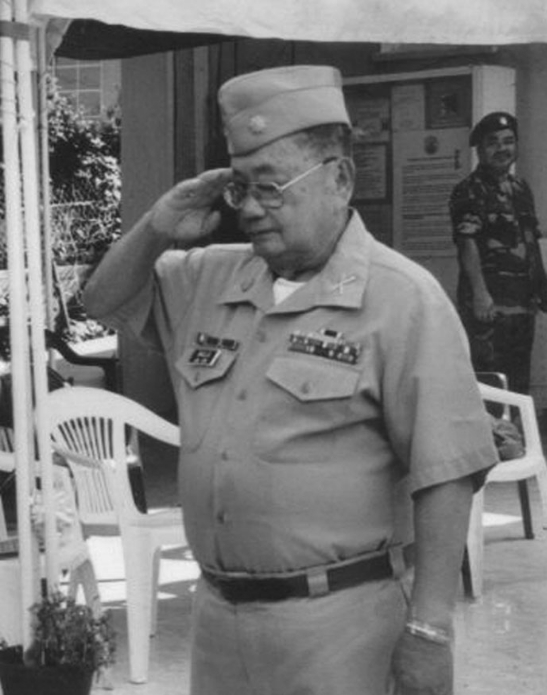
During World War II (1939-1945), the Philippines was a territory of the United States. When Japan attacked the Philippines in 1941, Filipino soldiers fought alongside American troops. Approximately 250,000 Filipino soldiers served under the American flag, enduring brutal battles and the infamous Bataan Death March (1942). In 1946, Congress passed the Rescission Act, which denied these Filipino veterans the benefits they had been promised. In this lesson, students will learn about the story of Faustino "Peping" Baclig (1922-2011) and other Filipino WWII veterans who organized protests, lobbied Congress, and fought to gain recognition of their military service, and ultimately achieving partial victory with legislation passed in 2009.
Lesson Objectives:
Students will:
Identify the contributions of Filipino soldiers during World War II.
Analyze the civil rights strategies employed by Faustino "Peping" Baclig and other Filipino veterans.
Assess the effectiveness of different advocacy methods used by the Filipino veterans.
What factors led to Manong Peping joining the U.S. Army Forces in the Far East (USAFFE)?
What factors led to Manong Peping becoming a Prisoner Of War (POW) of the Japanese army?
What was the Bataan death camp and how did it impact Manong Peping?
How did Manong Peping become a U.S. citizen?
What limitations did he face in seeking U.S. veteran benefits, even as a citizen?
What was the Rescission Act of 1946?
What was the American Coalition for Filipino Veterans (ACFV)? What were its goals?
Why did Manong Peping and Manong Franco begin a vigil at the statue of General MacArthur in Los Angeles? What was their purpose? What is the significance of choosing this statue?
What legislative victories did Manong Peping win? In what ways did these victories fall short of the recognition Manong Peping wanted for Filipino veterans?
What provisions for Filipino soldiers were included in H.R.1 American Recovery and Reinvestment Act of 2009?
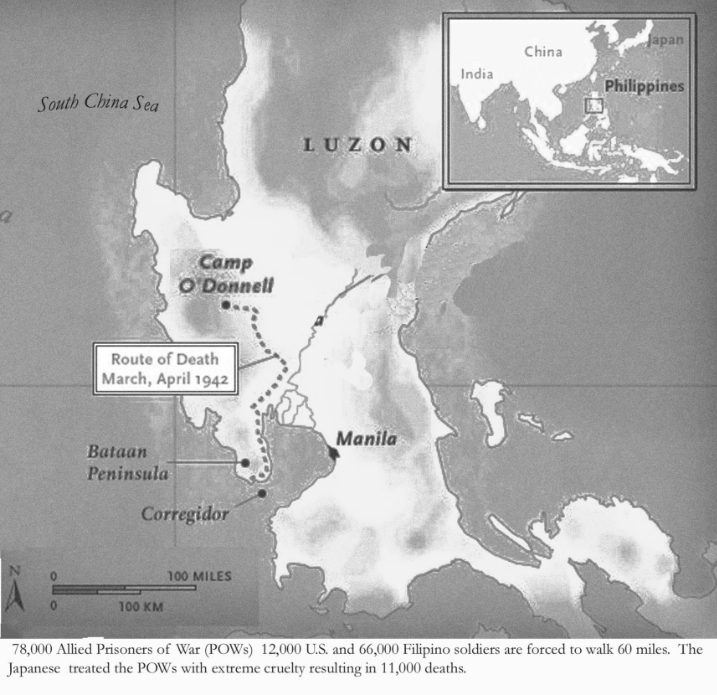
Map of the Philippines showing the route of Bataan Death March
Have students write the name and years of their assigned period at the top of the worksheet.
Have students respond to the following questions on the worksheet:
What are the top three features of this time period?
What event(s) led to this period in Philippine history?
What acts of Philippine resistance occurred during this period? What are the main impacts of colonial rule at this time?
How/why did this period end?
Have each group present a summary of their time period to the class.
Tell students the following: “It is important to understand the history of the Philippines because it helps us recognize patterns of colonization, resistance, and the ongoing struggle for sovereignty that shaped the nation. Understanding this historical context is essential for comprehending why the Philippines became such a strategic and contested location during World War II, and how centuries of colonial rule influenced the Filipino people's response to yet another foreign occupation during the Japanese invasion.”
Activity 2: Analyzing the Strategic Location of the Philippines
Tell students the following: “When World War II began in 1939, the Philippines was controlled by the United States. In 1941, President Franklin D. Roosevelt (1882-1945) ordered the Commonwealth Army of the Philippines, and the U.S. Armed Forces, in the Philippines to be merged. This merger resulted in the formation of the U.S. Army Forces in the Far East (USAFFE). The USAFFE included 19,000 U.S. army soldiers, 12,000 Philippine Scouts, and 118,000 Commonwealth of the Philippines soldiers.”
Show students a map of the Philippines. Ask students the following:
Where is it situated in Southeast Asia?
What is its proximity to Japan?
What is its proximity to the United States?
What is its position along major Pacific shipping routes?
Where are the harbors at Manila Bay and Subic Bay? Why might these be strategic positions?
What is strategic about its location between the South China Sea and the Pacific Ocean?
Facilitate a discussion by asking the following question: “Why might the Philippines be an important strategic location for the United States and for Japan during World War II?”
Tell students the following: “The Philippines was strategically important to the United States during World War II for several reasons. First, it served as a critical military base protecting U.S. interests in the Pacific. Second, it controlled vital shipping lanes between Asia and the Americas. Third, it provided a defensive barrier against Japanese expansion southward and offered deep-water ports for the U.S. Navy. Fourth, for Japan, controlling the Philippines was essential to securing oil and raw materials from Southeast Asia, protecting their southern flank, cutting off Allied supply lines, and establishing their Greater East Asia Co-Prosperity Sphere. Fifth, its location made them a crossroads of Pacific power—whoever controlled the Philippines could project military force throughout the region.”
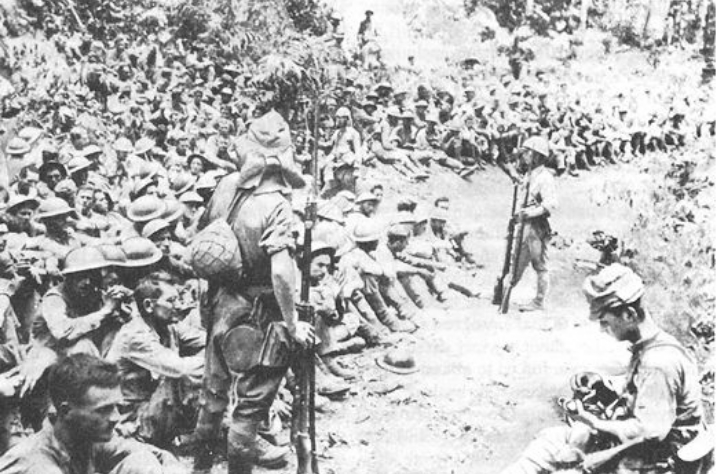
Japanese soldiers stand guard over American and Filipino prisoners of war before the start of the Bataan Death March in 1942.
Photo Courtesy of The American Coalition For Filipino Veterans, Inc.
Facilitate a class discussion by asking students the Discussion Questions.
Create and display the following chart for all to see:
Challenge
Act of Resistance
Impact
Have students list the challenges that Manong Peping faced in his life in the left column. Have students list ways that he responded to these challenges through acts of resistance in the middle column. Have students identify the impact of Manong Peping’s acts of resistance in the right column.
Facilitate a discussion by asking the following questions:
What were Manong Peping’s motivations for his actions?
Who benefitted from Manong Peping’s actions?
Display the following quote from Manong Peping: “It is less painful to remember the atrocities and brutalities of the war than to think of the denial of our military service in the U.S. Armed Forces.” Facilitate a discussion by asking the following questions:
What does this quote mean?
What does this quote suggest about what Manong Peping perceived as the most significant challenges in his life?
What is being compared and contrasted in this quote? What is the rhetorical significance of this comparison? How does it emphasize the point or meaning of the quote?
Ensure that students note the date of the article (October 31, 2023). Ask students the following question: Why is the date significant?
Have students add additional information to the worksheet using the article.
Have students complete the fifth row of the worksheet for the proposed bill, “Filipino Veterans Fairness Act.”
Tell students the following: “The Filipino Veterans Fairness Act has been introduced in almost every session of Congress since 1993. But it still has not been passed as of 2025.”
Facilitate a discussion by asking the following questions:
What are the Filipino veterans asking for? Why do they feel like they deserve this? What barriers are they facing?
Why do you think the Filipino Veterans Fairness Act has never been passed?
If the Filipino Veterans Fairness Act passes, what precedent might it set for other groups seeking recognition for historical injustices?
The current Filipino Veterans Fairness Act focuses heavily on expanding acceptable documentation for benefits - why is this significant and what does it reveal about previous barriers?
What role did coalition-building and education play in the veterans' movement?
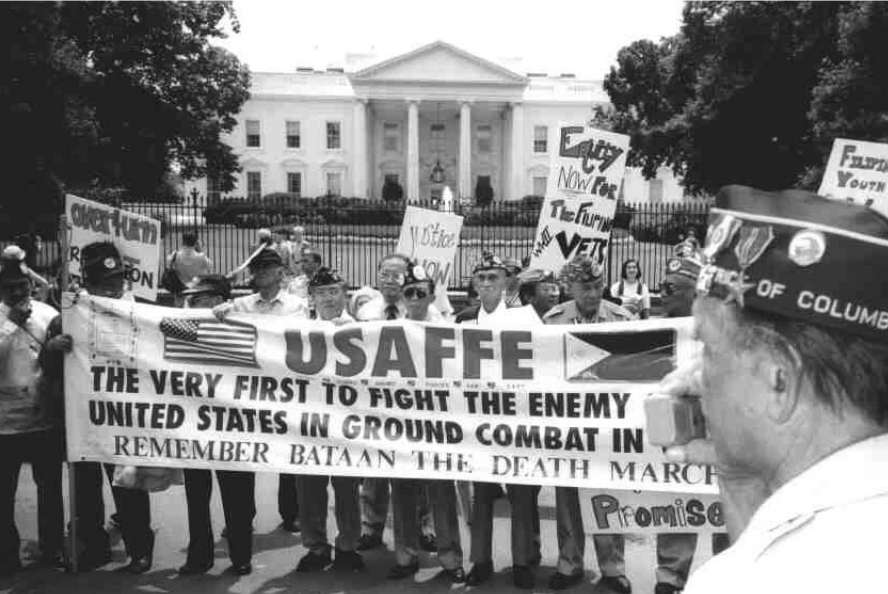
Filipino veterans demonstrating in front of the White House on July 21, 1998 to appeal to the president to recognize the military service of Filipino WWII veterans.
Photo Courtesy of The American Coalition For Filipino Veterans, Inc.
Activity 5: Analyzing Filipino Veterans' Unique Status and Benefits
Tell students the following: "Filipino soldiers who fought in World War II had a unique status that was different from other American veterans. Understanding this status is critical to understanding why they faced such significant barriers to benefits and recognition that other veteran groups did not face."
Create and display a chart with the following information:
Veteran Group
Citizenship Status during WWII
Status to U.S.
Promises Made for Enlisting/Serving
Benefits Received
Continental U.S. veterans
U.S. citizens
From U.S. states
Full veteran benefits
Full veteran benefits
Black American veterans
U.S. citizens
From U.S. states
Full veteran benefits
Limited benefits (due to discrimination in GI Bill implementation)
Filipino veterans (U.S. residents)
Many were Filipino nationals
N/A (immigrated to U.S.)
Full benefits if they became citizens
Denied benefits even after citizenship
Filipino veterans (Philippine residents)
Philippine Commonwealth nationals
From U.S. territory (not state)
Full veteran benefits promised
Denied benefits due to Rescission Act
Tell students: “During World War II, Filipinos living in the Philippines were U.S. nationals but not U.S. citizens. As residents of a U.S. territory rather than a state, they owed allegiance to the United States and could be drafted into military service, but they did not have the same citizenship rights as Americans living in the states. This distinction became crucial after the war when determining veteran benefits.”
Facilitate a discussion by asking the following questions:
What do you notice about the relationship between citizenship status and access to benefits?
How did the Philippines' status as a U.S. territory (not a state) affect Filipino soldiers' treatment?
Both Black American veterans and Filipino veterans faced barriers to benefits. How were their situations similar? How were they different? What accounts for these differences?
Why do you think the U.S. government made promises to Filipino soldiers during the war but then rescinded those promises in 1946?
Tell students the following statement: "During World War II, the U.S. government promised Filipino soldiers that if they fought for the United States, they would receive full veteran benefits, as well as a pathway to U.S. citizenship. Many Filipino soldiers were motivated to enlist because of these promises—they saw military service as a way to gain American citizenship and thus, provide a better future for their families. However, after the war ended and the Philippines gained independence in 1946, Congress passed the Rescission Act, which declared that Filipino military service would not be considered 'active service' for the purpose of benefits. This meant that even Filipino veterans who later became U.S. citizens, were often denied the same benefits as other American veterans." Encourage students to respond to this statement.
Activity 6: Summarizing Article about Manong Peping
Have students complete Section 1 (questions 1-3) by identifying how Manong Peping joined the U.S. Army Forces in the Far East, describing what the USAFFE was, and explaining the promises that were made to Filipino soldiers.
Have students complete Section 2 (questions 4-7) by examining the Philippines' territorial status during WWII and analyzing how this status affected Filipino soldiers' treatment compared to U.S. soldiers.
Have students complete Section 3 (questions 8-11) by identifying when the Philippines gained independence, explaining the Rescission Act of 1946, and analyzing Manong Peping's quote about the denial of benefits.
Have students complete Section 4 (question 12) by filling in the comparison chart with information about three different groups of Filipino veterans and explaining why some groups received benefits while others were denied.
Have students complete Section 5 (questions 13-15) by identifying Manong Peping's beliefs about race and veteran benefits, comparing the experiences of Black and Filipino veterans, and analyzing how citizenship, race, and colonialism intersected to determine benefit eligibility.
Facilitate a discussion by asking the following questions:
How did promises of U.S. citizenship motivate Filipino soldiers to enlist? What does this tell us about the power dynamics between the U.S. and the Philippines?
Even when Filipino veterans eventually gained U.S. citizenship, why were they still denied full benefits? What does this reveal about the role of race versus citizenship status?
How does understanding the intersection of race, citizenship, and colonial status deepen our understanding of why the fight for Filipino veteran recognition took so long?
What similarities do you see between how Black veterans and Filipino veterans were treated? What does this tell us about how race operated in veteran benefit policies?
Activity 7: Analyzing Change and Continuity in Veteran Advocacy
Tell students the following statement: “Continuity refers to patterns, practices, or conditions that remain the same over time. In relation to veteran advocacy, continuity might include the types of challenges veterans face, the strategies advocates use, or how the government responds to veteran needs. Change refers to developments, shifts, or transformations that occur over time. In relation to veteran advocacy, change might include new laws being passed, different advocacy methods, or evolving public awareness about veteran issues. Most historical issues show both continuity and change simultaneously. As we examine veteran advocacy from the 1940s through today, you will need to identify both what has remained consistent and what has transformed over these decades.”
Tell students, “We read about Manong Peping's fight for Filipino World War II veteran recognition from the 1940s to 2009. In this activity, we'll see how veteran advocacy connects across different time periods. As we watch videos about contemporary veteran groups, look for what has stayed the same as well as what has changed since Manong Peping's era.”
Divide students into three small groups and assign each group to watch a video and read an article about one of the following veteran advocacy groups:
Have students complete Section 1 (questions 1-4) by watching the DAV video and exploring the website, then analyzing DAV's benefits, comparing their transportation advocacy to Manong Peping's efforts, and examining how veteran advocacy strategies have evolved.
Have students complete Section 2 (questions 1-4) by watching the IAVA video and reading the article, then comparing advocacy attention across different veteran groups, identifying post-9/11 factors, and evaluating how advocacy methods have changed over time.
Have students complete Section 3 (questions 1-4) by watching the Agent Orange video and exploring the website, then explaining Agent Orange exposure, identifying health impacts, and analyzing the advocacy strategies Vietnam veterans used to fight for recognition and benefits.
Have each group present their findings to the class. Have students take notes on the other groups’ videos/articles to complete the worksheet.
Tell students to engage in partner talk given the following prompt: "Based on these videos, articles, and the Manong Peping reading, how has veteran recognition changed over time? What evidence supports your answer?"
Facilitate a discussion by asking the following questions:
How did the public and media response compare across these different veteran movements? How did this response impact veteran recognition over time?
How do these cases connect to the issues the Filipino veterans raised about government recognition and benefits?
Have students respond to the questions at the bottom of the worksheet. Facilitate a class discussion using students' responses to the questions:
What patterns do you see emerging about veteran advocacy across these decades?
What surprised you most about the differences in how these three time periods handled veteran issues?
How has your understanding of veteran experiences changed?
What role does media coverage play in determining which veteran issues receive public attention?
Based on these three cases spanning 80 years, what do you predict will be different about how society responds to veteran advocacy in the future?
Have students complete the second row by describing DAV's transportation advocacy approaches based on their video/article.
Have students complete the third row by describing IAVA's "Storm the Hill" and post-9/11 advocacy strategies.
Have students complete the fourth row by describing VVA's Agent Orange recognition efforts and the Orange Heart Medal initiative.
Have students complete the last column by analyzing the responses in the previous columns for each movement and identifying whether they see a continuity or a change. Have students include a justification of their thinking.
Facilitate a discussion by asking the following questions:
How might Manong Peping's experience have been impacted by previous veteran movements? How might it impact future veteran advocacy? How is the Filipino veteran experience connected to an 80-year pattern of veteran advocacy?
What do the patterns of continuity and change in veteran advocacy from 1940-2025 teach us about how to create lasting social change?
What does the creation of the Orange Heart Medal (outside official government channels) suggest about different paths to recognition?
Based on the evidence you've gathered, what has been most effective in fighting for veteran benefits over the past 80 years? What is your evidence?
Manong Peping and other Filipino veterans chose vigils, lobbying, and coalition-building as their main strategies. How does the Orange Heart Medal represent a different approach to the same underlying need for recognition?
What do the things that have NOT changed tell us about the root causes of veteran benefit denials? What would it take to break these persistent cycles?
Why is it important for activists and advocates to understand what has remained continuous over time? How might this knowledge change their strategies?
How and why is this data set limited in analyzing continuity and change in veteran advocacy?
Activity 8: Comparative Analysis of Filipino WWII Veterans and Other Groups
Tell students: "You have now examined the complex history of Filipino World War II veterans, including how citizenship status, colonial relationships, and race all intersected to create barriers to recognition and benefits. In this activity, you will compare the experiences of Filipino veterans with another group of veterans who also faced barriers to recognition or benefits. Through this comparison, you will develop a deeper understanding of patterns in how different groups of veterans have been treated throughout American history."
Assign the following essay prompt: “Write a comparative analysis essay that examines the experiences of Filipino World War II veterans with another group of veterans who faced barriers to recognition or benefits.”
Have students choose one of the following groups for the comparative analysis:
Option 1: Black American veterans and the GI Bill (Tell students to focus on discriminatory implementation after WWII.)
Option 2: Disabled American Veterans (DAV) (Tell students to focus on the ongoing need for medical transportation and support services.)
Option 3: Iraq and Afghanistan Veterans of America (IAVA) (Tell students to focus on post-9/11 veterans' advocacy and "Storm the Hill" efforts.)
Option 4: Vietnam veterans exposed to Agent Orange (Tell students to focus on the long fight for recognition of service-connected disabilities and the Orange Heart Medal.)
Facilitate a closing discussion by asking the following question: "How has learning about the continuity and changes in veteran advocacy from Manong Peping's time to today changed your understanding of how social movements evolve? How can you incorporate these lessons into your own civic engagement?"
Have students reflect and respond to the following prompt either in small discussion groups or by journaling: "Based on what you've learned about how veteran advocacy challenges have persisted over decades, identify one specific action you could take in your school, neighborhood, or community to support veterans or advocate for social justice when you witness inequality. Explain how understanding that some patterns of veteran advocacy have remained continuous, while others have changed over time, influences your choice of action and your expectations for creating change."
Extension Activities
Have students learn about the Filipino WWII Veterans Memorial in Los Angelese. Have students examine the memorial images and identify what physical elements, symbols, and text are included. Facilitate a discussion using the following questions:
What story does the memorial tell about Filipino veterans? Does it include the Rescission Act and the fight for recognition?
Why was it important to have a physical memorial in addition to legislative victories like HR 1?
Many Filipino veterans died before this memorial was created. How should we think about recognition that comes "too late"?
What purposes do memorials serve? What can they accomplish that legislation cannot, and vice versa?
Have students research local veteran organizations in their community and create a presentation on how these groups continue advocacy traditions.
Invite a Filipino American/Filipino veteran to speak at your school site.
Distinguish the powers and responsibilities of citizens, political parties, interest groups, and the media in a variety of governmental and nongovernmental contexts
D2.Civ.9.6-8:
Summarize the role of institutions in addressing social problems at the local, state, tribal, national, and/or international level
D2.His.1.6-8:
Analyze connections among events and developments in broader historical contexts
D2.Civ.10.9-12:
Analyze the impact and the appropriate roles of personal interests and perspectives on the application of civic ideals
D3.1.9-12:
Gather relevant information from multiple sources representing a wide range of views while using the origin, authority, structure, context, and corroborative value of the sources to guide the selection
Cite specific textual evidence to support analysis of primary and secondary sources
CCSS.ELA-LITERACY.RH.9-10.2:
Determine the central ideas or information of a primary or secondary source; provide an accurate summary of how key events or ideas develop over the course of the text
CCSS.ELA-LITERACY.RH.11-12.3:
Evaluate various explanations for actions or events and determine which explanation best accords with textual evidence, acknowledging where the text leaves matters uncertain
CCSS.ELA-LITERACY.RH.11-12.7:
Integrate and evaluate multiple sources of information presented in diverse formats and media in order to address a question or solve a problem