The Immigrant Who Saved Florida’s Oranges
Grade: 6-9Subject:
U.S. History, Social Studies, English Language Arts, Mathematics, Science
Number of Lessons/Activities: 6
Lue Gim Gong (c. 1857-1925) was a Chinese American horticulturist. He immigrated to the United States from China as a young teenager, and eventually settled in DeLand, Florida. There, he used cross-pollination and planting techniques to develop new strains of fruit. Most notably, he developed the Lue Gim Gong orange (a strain of the Valencia orange) that was more resistant to frost. In this lesson, students will learn about the life of Lue Gim Gong and the circumstances that led him to become known as the “Citrus Wizard of Florida.” Students will examine challenges he faced and his responses. They will be introduced to Punnet squares for predicting genotypes. They will also examine data on DeLand’s weather to create graphs.
Students will:
- Describe events in the life of Lue Gim Gong.
- Identify Lue’s contributions to the citrus industry.
- Explain the purpose of a Punnet square.
- Create a data visualization showing the severity of the Great Freeze in Florida.
Lue Gim Gong (c. 1857-1925) was a
horticulturist and prominent early Chinese American pioneer in the U.S. South. The son of farmers, Lue was born between 1857 and 1860 in the Guangzhou region of southeast China. He immigrated to the United States in 1872 as a teenager. He first settled in San Francisco, California and worked in a shoe factory. Soon after, he was recruited to work in a shoe factory in North Adams, Massachusetts. Once there, Lue joined a group of Chinese workers who had been hired in 1870 by factory owner Calvin T. Sampson (1826-1893). They were hired as
strikebreakers to replace Irish factory workers who were fighting for better pay and conditions. The North Adams Strike and Sampson’s use of Chinese labor would garner national attention. Sampson purposefully pitted Chinese workers against Irish workers. This contributed to the anti-Chinese sentiment that led to the passage of the
Chinese Exclusion Act in 1882.
In North Adams, Lue participated in American society. He attended a Chinese Sunday school where he learned English. He joined a local Baptist church and
converted to Christianity. One of his teachers was a woman named Fannie Burlingame (1828-1903). She took a special interest in Lue. She was impressed with his curiosity and intellect. She learned he was skilled with plants. Eventually, she invited him to live in her home to tend the family garden. She became a
surrogate mother to Lue who would refer to her as “Mother Fannie.”
Around 1885-1886, Lue suffered from the cold climate of New England. He developed a bad case of
tuberculosis. He returned to China to recover. However, Lue’s family did not approve of his newfound Christianity. They attempted to arrange a marriage for him to stay in China. Lue refused the marriage and quickly returned to the United States with the assistance of Burlingame. By this time, the Chinese Exclusion Act of 1882 had passed. This law prohibited Chinese laborers from entering the United States. This should have prevented Lue’s return. It is unclear how exactly Lue bypassed this law. Some historical evidence suggests that the Burlingame family
forged business documents for Lue. (The Chinese Exclusion Act made exceptions for merchants and students.) Lue later became a U.S.
citizen in 1887. Again, this happened with Burlingame’s assistance.
After returning to the United States, Lue rejoined the Burlingame family. The Burlingames owned an orange grove in DeLand, Florida. As a child, Lue had been taught by his mother about
cross-pollination and planting techniques. He quickly took to working in the orchard and planted fruit trees. In the 1890s, a series of freezes killed the Burlingame family’s harvest. This motivated Lue to develop a more resistant
strain. Lue crossed two types of oranges: Florida Harts Late and Mediterranean Sweet. He developed what would be called the Lue Gim Gong orange. (This would later be identified as a strain of the more popular Valencia orange).
The Lue Gim Gong orange was not only resistant to frost, but was also bred to prevent dropping prematurely. This allowed the orange to stay on the tree for years at a time after ripening. In addition, its hardiness made it ideal for shipping. Lue was generous in providing cuttings of his plants to visitors. This orange was grown widely. By some estimates, the Lue Gim Gong orange and its qualities saved the citrus industry millions of dollars. He would also later go on to develop a similar grapefruit and other special fruit strains. For these accomplishments, Lue was often referred to as the “Citrus Wizard of Florida” or the “Chinese Burbank of Florida.” (This was a reference to famed horticulturist Luther Burbank [1849-1926]). In 1911, Lue was awarded the Silver Wilder Medal by the American
Pomological Society. This was the first time the medal was awarded for citrus.
Lue made additional contributions. He developed an apple that ripened a month earlier than other varieties. He developed tomatoes that grow in clusters. He developed a peach that would ripen in late November. He developed different types of grapefruits. One grapefruit variety grew individually rather than in clumps. One was cold-tolerant and slower to drop. One had a strong fragrance.
After Burlingame died in 1903, she left her property and wealth to Lue. However, Lue was not a skilled businessman. He lived out the rest of his life at the Burlingame house in relative poverty despite his success. Lue died in 1925, accompanied only by his horses named Baby and Fannie, and a pet rooster named March. Since then, Lue has been honored and remembered for his life and accomplishments by historians, horticulturists, and Floridians. He changed Florida’s citrus industry. He also increased the seasonal range for many orchard-grown trees. His work has benefitted generations of farmers and citrus-lovers!
Bibliography:
- Chinese Exclusion Act of 1882: law that severely restricted the entry of Chinese to the United States and excluded Chinese people from becoming citizens**
- Citizen: a native or naturalized person who owes allegiance to a government and is entitled to protection from it
- Convert: to bring over from one belief, view, or party to another, especially from one religion to another
- Cross-pollination: the transfer of pollen from one flower to the stigma of another
- Forge: to make or imitate falsely especially with intent to defraud
- Grove: a small wood or group of trees without underbrush
- Horticulturist: a person whose work involves growing fruits, vegetables, flowers, or ornamental plants
- Pomological: relating to the science and practice of growing fruit
- Strain: a group of plants or animals that look alike but have characteristics (as the ability to resist disease) that make them slightly different
- Strikebreaker: a person hired to replace workers who have stopped work in order to force an employer to comply with demands for better working conditions
- Surrogate: one that serves as a substitute
- Tuberculosis: disease of human beings and some other vertebrates caused by a bacterium and usually marked by wasting, fever, and formation of cheese-like tubercles that in human beings occur mostly in the lungs
- What were Lue Gim Gong’s early years in the United States like?
- Who was Fannie Burlingame? What impact did she have on Lue’s life?
- How did the Chinese Exclusion Act impact Lue?
- How did Lue’s knowledge of cross-pollination and planting techniques help him in Florida?
- What circumstances led Lue to develop the Lue Gim Gong orange?
- How did Lue contribute to Florida’s citrus industry?
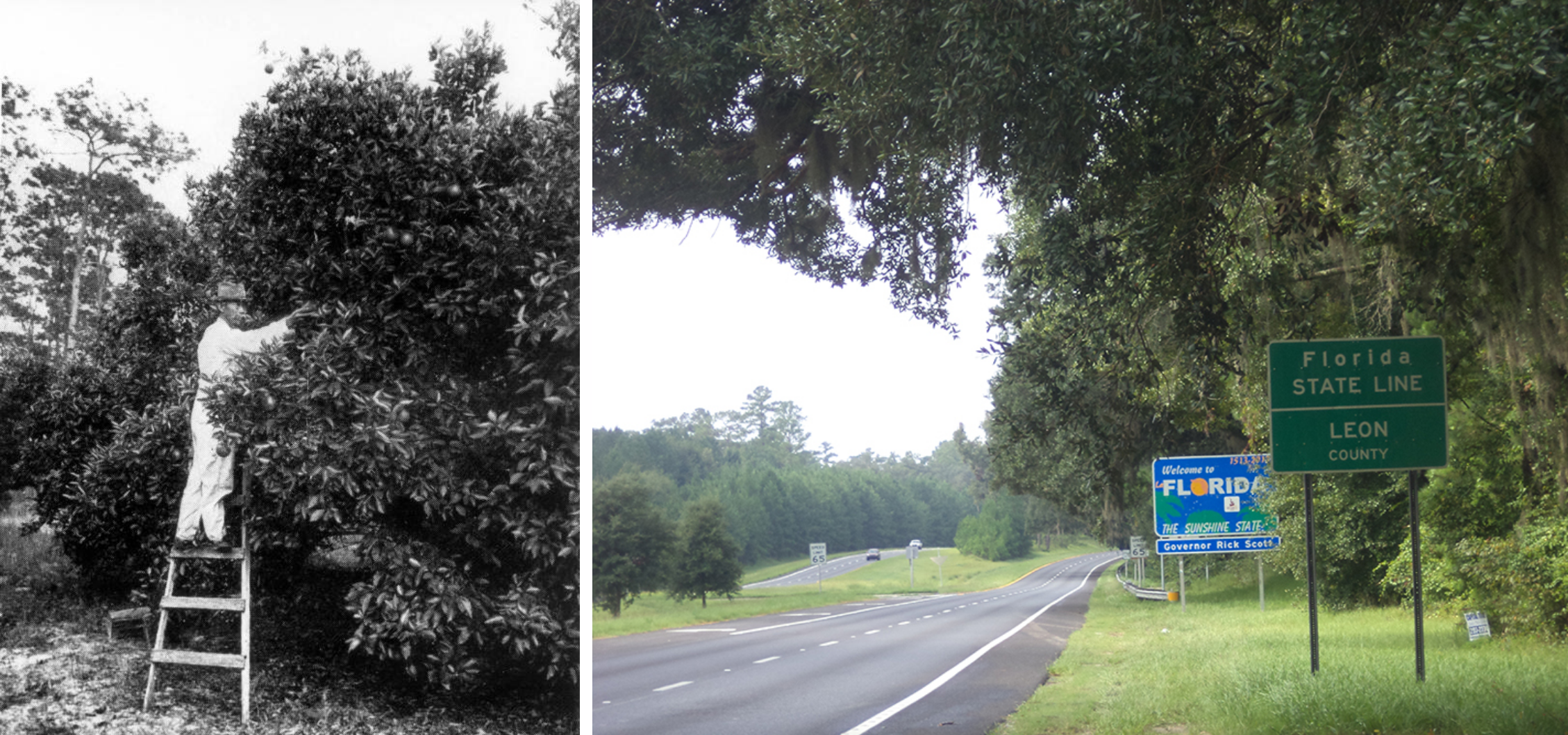
Left: Lue Gim Gong picking an orange. Right: State sign of Florida.
Credit (left): State Archives of Florida (Public Domain)
Source Credit (right): Michael Rivera via Wikimedia Commons (
CC BY-SA 3.0)
Source
Activity 1: Building Background on Florida’s Citrus Industry
- Have students pair-share about their favorite citrus fruit.
- Show students a state sign of Florida. Have students describe what they see. Ask students, “Why is Florida called ‘the sunshine state’?”
- Tell students the following: “Florida is one of the world’s largest producers of citrus. In 2021, the citrus industry contributed nearly $7 billion to Florida’s economy.”
- Ask students, “Why would Florida be a good place to grow citrus?” Have students share ideas and then conduct internet research to answer this question. Have students share their findings.
- Ask students, “What factors could threaten the citrus industry in Florida?” Have students share ideas and then conduct internet research to answer this question. Have students share their findings.
- Tell students the following: “This lesson is about Lue Gim Gong, a Chinese American horticulturist who became known as the ‘Citrus Wizard of Florida.’ From 1895-1896, the Great Freeze in Florida devastated the citrus industry. Gong used his cross-pollination skills to develop a strain of oranges that was more resistant to frost.”
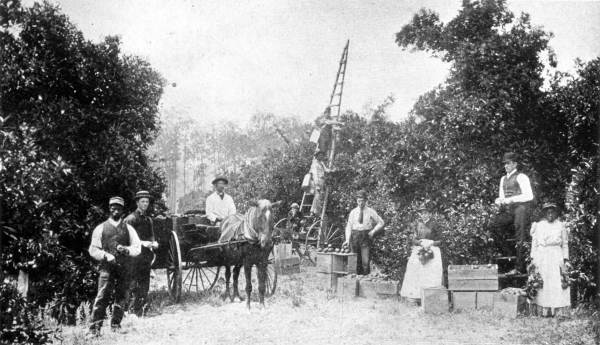
Lue Gim Gong in an orange grove.
Credit: State Archives of Florida (Public Domain)
Activity 2: Learning about Lue Gim Gong
- Have students read the essay. Consider the following options:
- OPTION 1: Have students read the essay independently either for homework or during class time.
- OPTION 2: Read aloud the essay and model annotating.
- OPTION 3: Have students read aloud in pairs or small groups.
- Facilitate a class discussion by asking students the Discussion Questions.
- Create and display the following chart for all to see:
- Have students use information from the essay to complete the chart together. Have students list challenges Lue faced in his life in the left column. Have students list ways he responded to those challenges in the right column.
- Have students watch the video entitled, “Rollins Professor Wenxian Zhang Shares Life Story of Lue Gim Gong for AAPI Heritage Month” (Rollins College).
- Have students watch the video entitled, “The Immigrant Who Saved Florida’s Oranges” (1990 Institute).
- Have students add to the chart using information from the videos.
- Facilitate a discussion by asking the following questions:
- What were the main barriers that Lue faced in his life?
- What were Lue’s main resources or assets? How did Lue use these resources?
- What enabled Lue to achieve success?
- What problems did Lue face and how did he solve them?
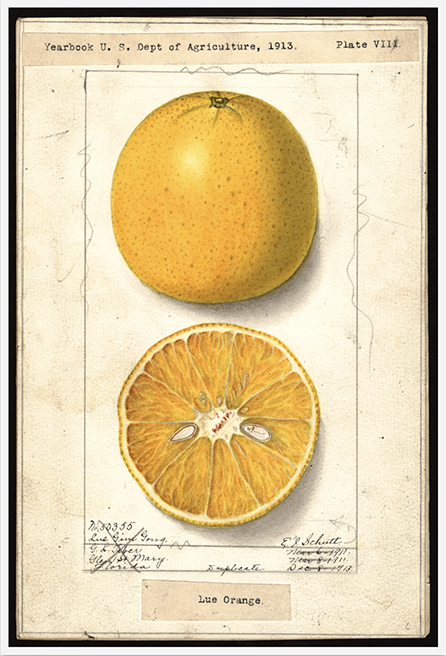
Watercolor painting of the Lue Gim Gong orange, also known as Citrus sinensis: Lue Gim Gong.
Credit: Ellen Isham Schutt, U.S. Department of Agriculture Pomological Watercolor Collection (Public Domain)
Activity 3: Connecting Lue Gim Gong to Punnet’s Square
- Facilitate a discussion by asking the following questions:
- What motivated Lue to develop the Lue Gim Gong orange?
- What specific problem did Lue solve?
- How did he develop the Lue Gim Gong orange?
- Tell students the following: “Lue crossed two types of oranges: Florida Harts Late and Mediterranean Sweet. Scientists use a visual tool called Punnet squares to predict the genotype two individuals can produce when crossed. The Punnet square is named after Reginal Punnet, an English geneticist who developed it in 1905.”
- Post the following definitions for all to see and explain each concept to students (or have students define words for homework):
- Cross-pollination: process of transferring pollen from one flower of a plant to the flower of a different plant
- Phenotype: observable physical traits
- Genotype: genetic makeup
- Probability: chance or likelihood that a given outcome will occur
- Trait: characteristic of an organism that can be inherited or environmentally determined
- Dominant: stronger of two expressed genes; represented by an uppercase letter
- Recessive: weaker of two expressed genes; represented by a lowercase letter
- Allele: a variant of a gene
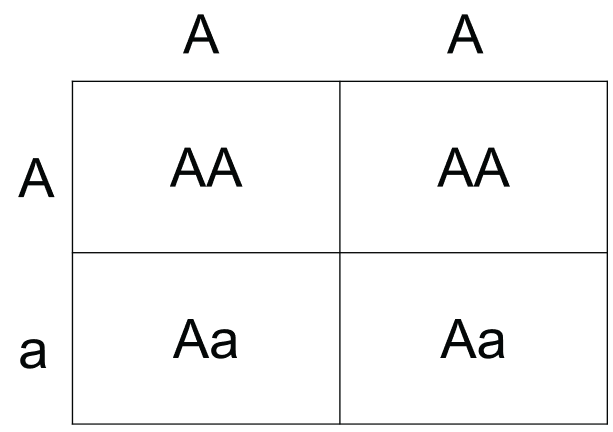
- Model the following example of a Punnet square:
- Explain that in this example, one parent has AA alleles (two dominant alleles, represented along the top) and one parent has Aa alleles (one dominant and one recessive, represented on the left side).
- Explain that to determine the possible different genotypes of their offspring, cross the allele in the top with the allele on the side and write the resulting combination in the corresponding box. Note that the dominant (uppercase) allele is always written first.
- Demonstrate how to complete each box.
- Circle the top row. Explain that there is a 50% chance the offspring will have an AA genotype. Explain that because AA contains only the dominant allele, that would be the phenotype.
- Circle the bottom row. Explain that there is a 50% chance the offspring will have an Aa genotype. Explain that because Aa contains the dominant allele, that would be the phenotype. So, 100% of offspring will have the dominant trait.
- Walk students through additional examples using Punnet squares.
- Facilitate a discussion by asking students the following questions:
- How might Lue have used Punnet squares in his cross-pollination work?
- How can Punnet squares be used? What other applications do Punnet squares have?
- Tell students the following: “We do not know if Lue used Punnet squares, but his work in cross-pollination used the same ideas. Math and science have multiple origins. Many groups come to the same conclusion via lived experience and observation. It’s important to recognize native and cultural knowledge.”
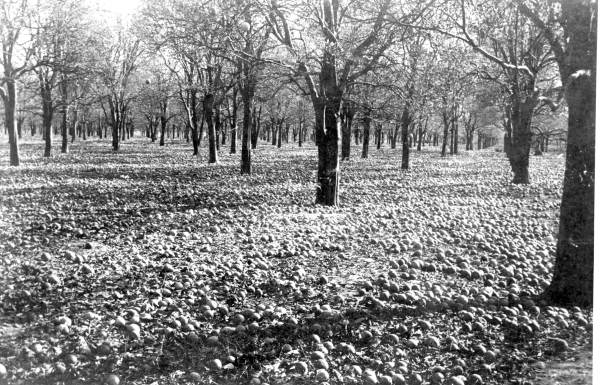
Many orange groves were damaged during the Great Freeze of December 1894 and February 1895.
Credit: State Archives of Florida (Public Domain)
Activity 4: Visualizing Data from the Great Freeze of 1894 and 1895
- Have students conduct internet research to complete the worksheet entitled, “Average Temperature in DeLand, Florida.”
- Have students write the average high temperature for each month in the middle column.
- Have students write the average low temperature for each month in the right column.
- Have students cite their source(s) at the bottom of the worksheet.
- Display the chart for all to see and have students draw conclusions from the data:
|
|
Average HIGH temperature in DeLand, Florida
|
Average LOW temperature in DeLand, Florida
|
| January
|
|
|
| February
|
|
|
| March
|
|
|
| April
|
|
|
| May
|
|
|
| June
|
|
|
| July
|
|
|
| August
|
|
|
| September
|
|
|
| October
|
|
|
| November
|
|
|
| December
|
|
|
- Ask students, “What type of graph would be helpful in presenting the data on this chart?”
- Have students choose a type of graph (i.e., bar graph, line graph, scatter plot, etc.) and create a graph using the data.
- Have students share their graphs and discuss the pros and cons of each type of graph for representing the data. Allow students to revise their graphs based on feedback.
- Tell students the following: “The Great Freeze was a period of freezes in Florida. Two freezes – one in December 1894 and one in February 1895 – hit record low temperatures and destroyed much of the state’s citrus crops. The freezes killed the Burlingame family’s harvest and motivated Lue to develop a strain that was more resistant to frost.”
- Show students the data on the following webpages: (1) Deland Weather in 1894 and (2) Deland Weather in 1895.
- Ask students what they observe about the data.
- Ask students which data might be relevant to understanding the Great Freeze.
- Point out the record lows on December 30, 1894 (16 degrees Fahrenheit) and February 8, 1895 (17 degrees Fahrenheit).
- Have students calculate the average temperature in December 1894 and February 1895. Have students compare these averages to the overall averages recorded in the table.
- Have students choose a way to represent the data from 1894 and 1895. Have students decide how to display this data alongside the graphs they created on average temperatures to show the severity of the Great Freeze.
- Tell students the following: “Citrus production during the winter of 1894-1895 fell from a high of 6 million boxes to 50,000 boxes. We do not know the exact impact of Lue Gim Gong’s new orange, but some estimates suggest that his orange saved the industry millions of dollars in the years to come.”
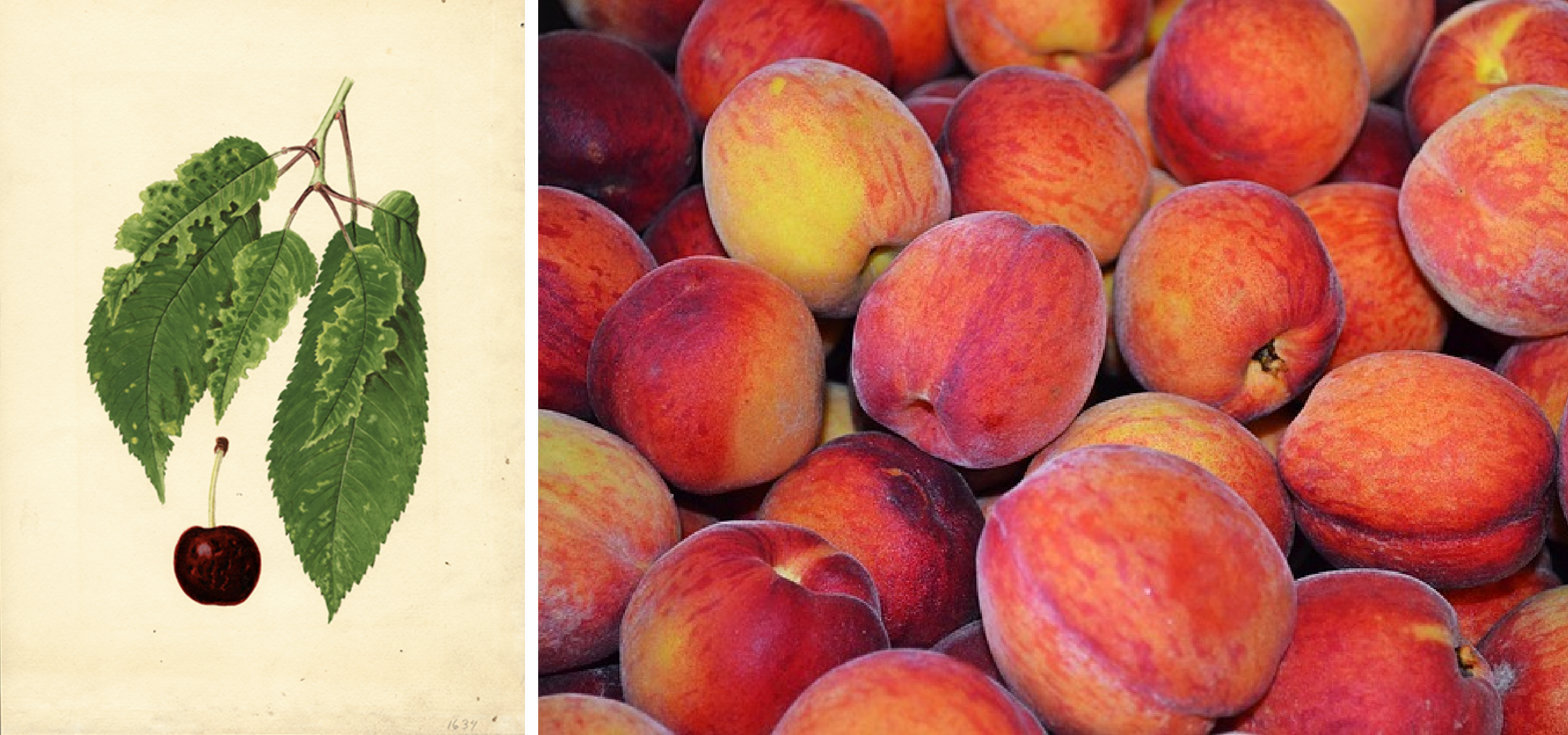
In Activity 5, students research other Asian American pioneers in agriculture, such as Ah Bing (1893-1950), the namesake of the Bing Cherry, and Didar Singh Bains (1938-2022), the “Peach King.”
Credit (left): James Marion Shull, U.S. Department of Agriculture Pomological Watercolor Collection (Public Domain)
SourceCredit (right): krzys16 via Pixabay (Free to use under Pixabay Content License)
Source
Activity 5: Researching Asian American Pioneers in Agriculture
- Tell students the following: “Lue Gim Gong was known as the ‘Citrus Wizard of Florida.’ Many Asian American immigrants brought over the agricultural skills they learned in their native countries. They applied their knowledge in the United States. They significantly shaped U.S. agriculture.”
- Have students research an Asian American pioneer in agriculture. Examples include Ah Bing (1893-1950) who is the namesake of the Bing Cherry, the Sandhu family who is known as the “Almond Kings of California,” and Didar Singh Bains (1938-2022) who is known as the “Peach King,” etc.
- Have students complete the worksheet entitled, “Researching Asian American Pioneers in Agriculture” as they do their research:
- Have students list the name of the person in the top row.
- Have students list their life years in the second row.
- Have students write a brief biography in the third row.
- Have students write what the person is known for in the fourth row.
- Have students describe their accomplishments in the fifth row.
- Have students describe their impact in the fifth row.
- Host a “Farmers Market” where students pretend to be the person they studied and share some of the crops.
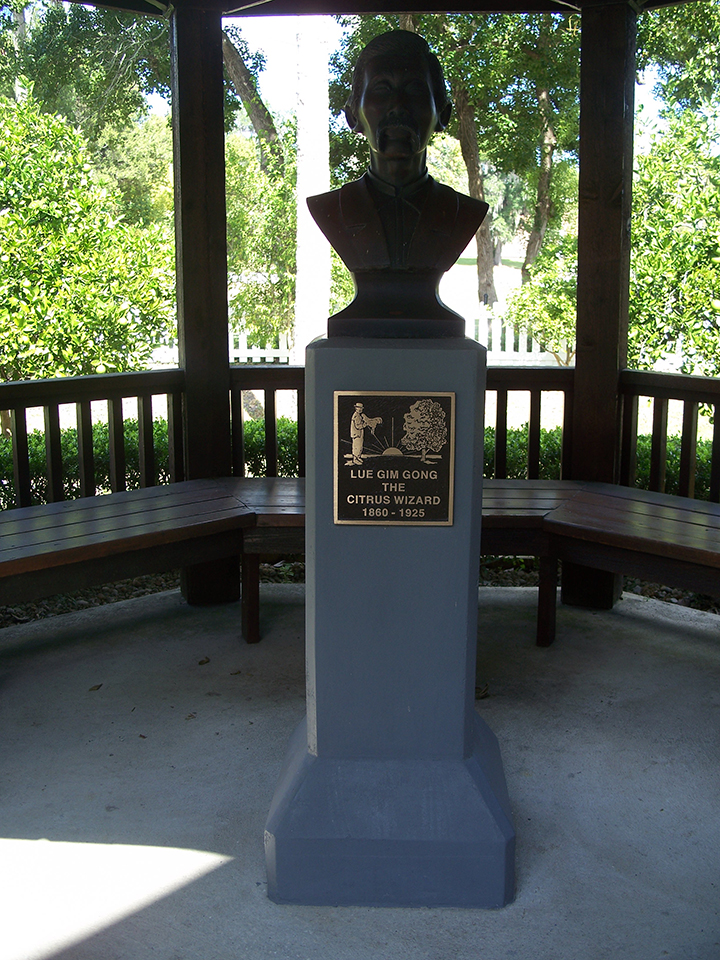
Memorial bust of Lue Gim Gong in Deland, Florida.
Activity 6: Analyzing Preservation Efforts
- Tell students the following: “Not many people know about Lue Gim Gong. There have been several efforts to memorialize Lue Gim Gong’s legacy.”
- Have students work in small groups and assign each group to research one of the following topics and present a 10-minute lecture to the whole class:
- Group 1: Gim Gong Road in Oldsmar, Florida
- Group 2: Ruthanne Lum McCunn’s (born 1946) book entitled, “Wooden Fish Songs”
- Group 3: Influence on the Guixia orange and Wuyuehong orange varieties in China
- Group 4: Recognition as a “Great Floridian” by the Florida Department of State
- Group 5: Mural entitled, “Futurity” in North Adams
- Facilitate a discussion by asking students the following questions:
- What do all these preservation efforts have in common?
- How do these preservation efforts differ and what accounts for these differences?
- What are the limitations of these preservation efforts? How do they fall short of preserving and honoring his legacy?
- Have students write a proposal for how they would preserve and memorialize Lue Gim Gong’s life and legacy.
- Have students explore images and records from The University of South Florida’s Lue Gim Gong collection. Have students select one document to closely examine and write a paragraph about.
- Have students research the current decline in Florida’s citrus industry. Have students find out the factors that are leading to the decline and potential solutions to address these factors. Have students create a poster, video, or social media post sharing what they learned. Encourage students to pursue a science experiment to solve the problem.
- Host an orange taste test. Bring in a variety of oranges and have students taste each one. Have students write a review card for each orange, rating it for sweetness, juiciness, and other factors. How students rank the oranges. Have students create graphs or other visual representations based on the data collected.
- Teach a science lesson in which students understand the difference between a hybrid versus nucellar seedling. Have students explain how and why Lue Gim Gong’s orange variety is categorized as a “strain.”
D2.Geo.4.6-8.
Explain how cultural patterns and economic decisions influence environments and the daily lives of people in both nearby and distant places.
CCSS.Math.Content.6.SP.B.4
Display numerical data in plots on a number line, including dot plots, histograms, and box plots.
MS-LS3-2.
Develop and use a model to describe why asexual reproduction results in offspring with identical genetic information and sexual reproduction results in offspring with genetic variation.
SS.7.G.2.3
Explain how major physical characteristics, natural resources, climate, and absolute and relative location have influenced settlement, economies, and inter-governmental relations in North America.
SS.912.G.3.2
Use geographic terms and tools to explain how weather and climate influence the natural character of a place.
MA.6.DP.1.2
Given a numerical data set within a real-world context, find and interpret mean, median, mode and range.
MA.6.DP.1.5
Create box plots and histograms to represent sets of numerical data within realworld contexts.
MA.7.DP.1.5
Given a real-world numerical or categorical data set, choose and create an appropriate graphical representation.
MA.8.DP.1.1
Given a set of real-world bivariate numerical data, construct a scatter plot or a line graph as appropriate for the context.
SC.7.L.16.2
Determine the probabilities for genotype and phenotype combinations using Punnett Squares and pedigrees.