All lesson plan content is owned by The Asian American Education Project (AAEdu) and source content is owned by Sikh American Legal Defense and Education Fund (SALDEF) and Sikh American History Project (SAHP). Users agree to attribute work to AAEdu, SALDEF, and SAHP.
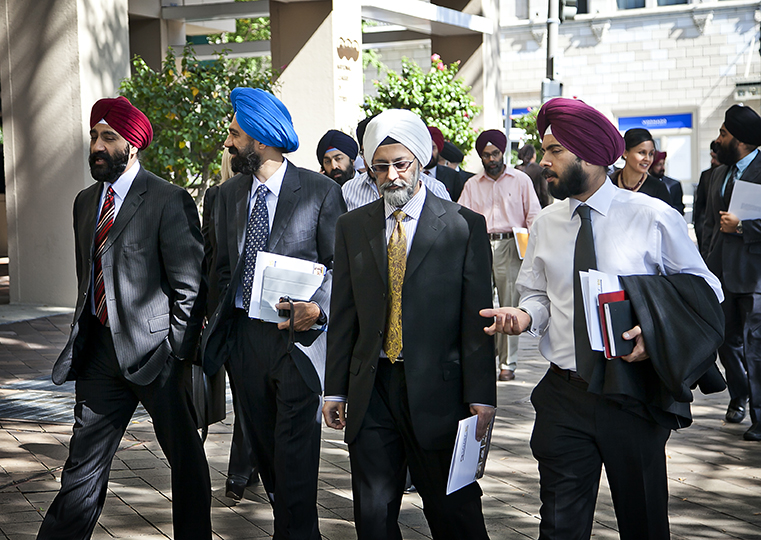
Many Sikhs wear turbans to represent their values of faith, equality, and justice.
Grade: 9-12Subject:
U.S. History, Social Studies, English Language Arts
Number of Lessons/Activities: 3
The Sikh turban represents the values of faith, equality, and justice. Negative perceptions of the turban held by many White Americans are a result of immigration patterns, stereotypes, media portrayals, and global events. In this lesson, students will learn about the origins of myths that have formed about Sikh turbans. Students will also analyze how American perceptions of the turban have been shaped by historical events.
Students will:
- Explain what a Sikh turban is and what it represents.
- Identify the historical contexts that have impacted American perceptions of the turban.
- Assess the historical significance of a historical event to determine how it impacted American perceptions of the turban.
The
Sikh turban is worn by men and some women. It serves two main purposes. First, it covers their uncut hair. Second, it represents their values. The turban was a traditional sign of leadership and royalty in South Asia. It was adopted by the Sikh community along with four other articles of faith designated by their tenth
Guru (prophet-teachers) in the 17th century. [Note: In Sikhism, there are five articles of faith:
Kesh (uncut hair),
Kirpan (religious sword),
Kara (metal bracelet),
Kanga (comb),
Kaccha/Kachera (under-shorts), each worn as a symbol of their commitment to their faith.] Together, these articles of faith represent equality, self-respect, service, and a commitment to justice for all.
Most of the people in the United States who wear turbans are Sikhs. This is due to immigration patterns. Large numbers of South Asian laborers came to the United States in the late 19th century and early 20th century. Most of the arrivals originated from the northern region of India known as Punjab. These early
immigrants were diverse in some ways. But, many came from similar ethnic backgrounds. They also had the shared experience of living abroad as former soldiers in the Indian military. These prior travel experiences helped situate them as ideal candidates to work in foreign employment. Most were also members of the Sikh faith. As such, most of these men would wear turbans as part of their practice.
Most Sikh migrants came to the United States and Canada as laborers on farms, lumber mills, and railroads. They lived and worked in California, Oregon, Washington, and British Columbia. As Asian immigrants became a major labor force in the West, anti-Asian sentiments also increased. Many White workers held racist and
xenophobic views toward foreigners. They saw them as threats to their jobs and livelihoods. Media and public opinion often focused on the turban as a symbol of a perceived foreign threat. It was a point of “otherness.” For example, in 1910,
The Forum published a journal article entitled, “The Tide of Turbans.” The turban was described as “the badge and symbol of their native land, their native customs and religion…the twisted turban shows white or brilliant, a strange, exotic thing in the western landscape.” Newspapers referred to the wave of South Asian immigrants as the “Tide of Turbans.” This supported “
Yellow Peril,” the idea that Chinese and other East Asian migrants were a threat to Western ideals and ways of life.
The Luce-Celler Act of 1946 allowed increased immigration and naturalization for Indian immigrants by setting a
quota of 100 people per year from India. During the Civil Rights Movement of the 1960s, the activism of Black leaders led to the review of discriminatory immigration laws. The resulting Immigration and Nationality Act of 1965 ended the quota system which had served to exclude and prevent Asian immigration. It instead shifted the focus to professional status and family reunification. Both of these laws led to an increase in Sikh immigration.
After the passage of these two acts, more Sikhs immigrated from India and the South Asian diaspora. They began to settle in new communities. They established
gurdwaras. Yet, their turbans continued to signal to many White Americans that they were
perpetual foreigners. This means they were not seen as completely “American.” As turban-wearers, they did not conform to stereotypes of typical Americans.
Global American
diplomacy, popular media, tourism, and economic relations expanded. Public impressions of the turban shifted. Sometimes turbans were associated with foreign
royalty and exotic lands. In other cases, such as during the
1979 Oil Crisis and
Iranian Hostage Crisis, turbans held an
adversarial meaning. Both of these events were rooted in the Iranian Revolution. Many Americans however were unaware of the distinctions between different faiths in the Middle East, West Asia, and South Asia regions. And so turbans were easily conflated with other religious clothing.
On September 11, 2001, an Islamist terrorist group hijacked airplanes to strike designated targets in New York City and Washington, DC. The turban became the predominant symbol associated with
terrorism. Images of Osama bin Laden (1957-2011), the mastermind of the attacks, were prominent in the media. Portrayals of terrorists in the media and across popular culture emphasized turbans and beards as a key characteristic. Public opinion polls indicated that most Americans would be suspicious of anyone they met with a turban. For example, a 2013 survey report,
Turban Myths, prepared by the Stanford University Peace Innovation Lab and the Sikh American Legal Defense and Education Fund (SALDEF), found that 20% of respondents would likely feel “apprehensive” or “angry” when encountering a stranger in public wearing a turban. Another 19% indicated that seeing a turban evoked other negative responses.
As a result, many Sikhs, Muslims, Arabs, and South Asians were subject to countless acts of bias, harassment, and discrimination. The Sikh turban was met with fear and those wearing them were
segregated. They were treated differently in public and by government security agencies. Many Sikhs experienced bullying in schools and discrimination in other settings because of their articles of faith.
A lack of education around the Sikh community and bias against the turban has caused real harm. These negative perceptions are myths. In reality, Sikhs wear turbans to represent their values of faith, equality, and justice.
Bibliography:
Andersen, Erika Surat, director. Turbans. Different Drum Productions, 2000. 30 min.
Scheffauer, Herman George. (1910). “A Tide of Turbans.” The Forum.
- 1979 Oil Crisis: an event during the Iranian Revolution in 1979 in which Iranian oil output declined leading to panic and speculative hoarding and a drastic rise in oil prices
- Adversaries: an enemy; one that contends with, opposes, or resists
- Article of faith: a firmly held Sikh belief
- Diplomacy: the art and practice of conducting negotiations between nations
- Gurdwara: a Sikh shrine or place of worship
- Guru: prophet-teachers in the Sikh faith; there are ten Gurus in Sikhism**
- Immigrant: a person who comes to a country to take up permanent residence
- Iranian Hostage Crisis: an event in 1979 in which a group of Iranian students seized the U.S. Embassy in Tehran and detained 52 Americans as diplomatic hostages for 444 days
- Perpetual Foreigners: a stereotype that is a form of systemic racism used against Asian Americans, historically stereotyped as foreigners in the United States no matter their duration living in the U.S. or whether they were American-born
- Quota: a proportional part or share; a fixed number or percentage needed to meet a specific requirement
- Royalty: of, relating to, or subject to the crown
- Segregate: to separate or set apart from others
- Sikh: a student and follower of Guru Nanak (b. 1469), the founder of the Sikh religious tradition, and the nine prophet-teachers (called Gurus) who succeeded him; the word Sikh means disciple or student**
- Terrorism: the systematic use of terror (violence, intense or overwhelming fear) especially as a means of coercion
- Turban: a head covering consisting of a long cloth that is wrapped around the cap or head
- Xenophobic: unduly fearful of what is foreign, and especially of people of foreign origin
- Yellow Peril: a term originating in Europe and the United States at the turn of the 20th century referring to the fear of Asian countries and Asian immigrants, whether it be a military threat from Asian nations, the economic threat of Asian Americans workers, or the threat to a White race posed by race-mixing and intermarriage.
** Definition adapted from
SALDEF
- Why do many Sikhs wear turbans?
- Why did Sikhs immigrate to the United States in the early 1900s?
- How was the turban perceived by other Americans during early Sikh immigration?
- How did perceptions of South Asians change as they became a major labor force in the West?
- What world events and historical context led to shifts in perceptions of Sikh Americans?
- How did the 9/11 attacks impact South Asian Americans?
- What are the “turban myths”? Why are these myths?
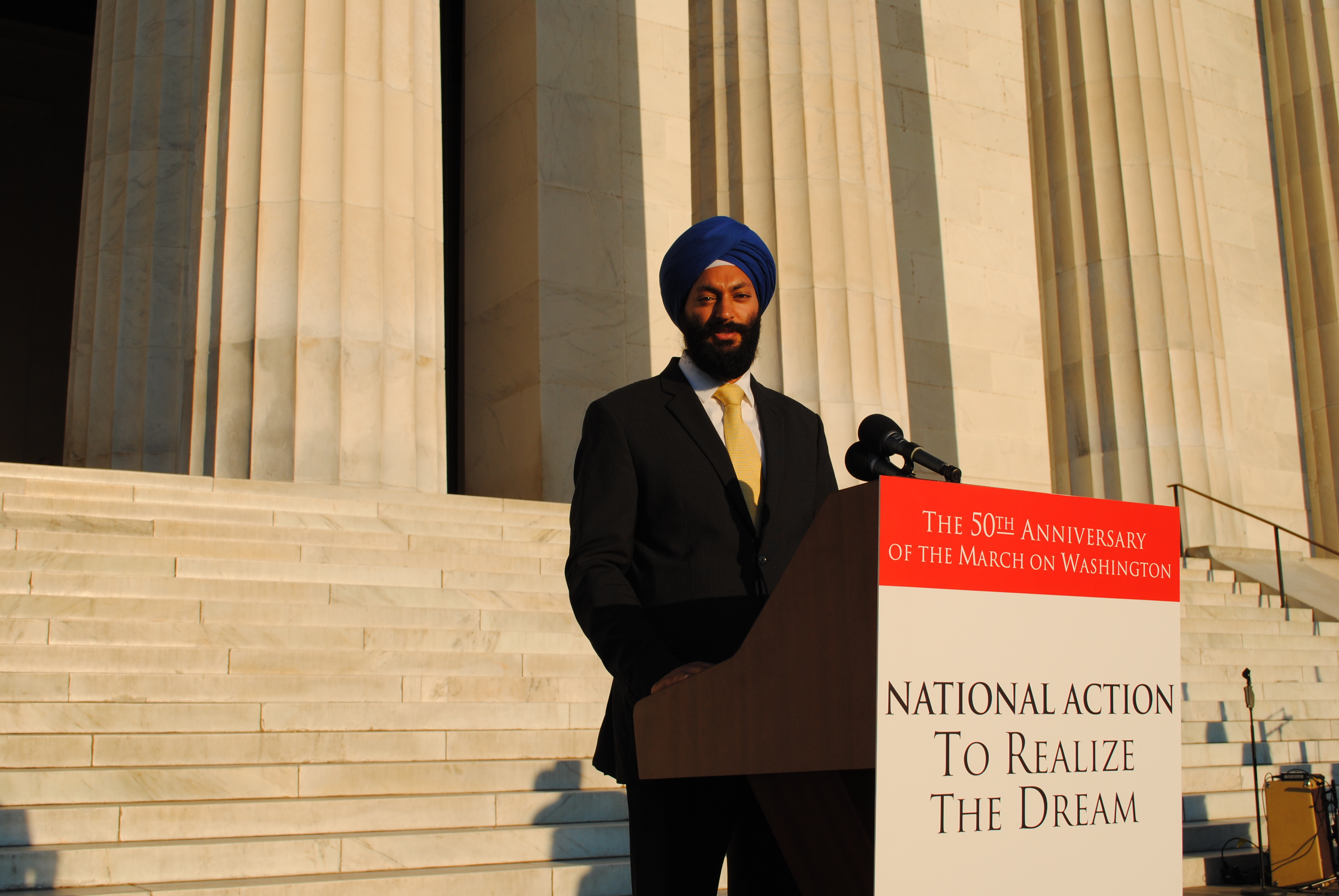
A representative from
SALDEF at the 50th Anniversary of the March on Washington in 2013.
Activity 1: Identifying the Significance of the Sikh Turban
- Have students take the survey in the SALDEF report entitled, “Turban Myths.”
- Review the results of the survey. (Read aloud pp. 24-29 for results, and pp. 30-33 for discussion.)
- Facilitate a discussion by asking the following questions:
- How did your responses compare to the survey respondents?
- Where do you think your preconceptions and knowledge (or lack of knowledge) came from? What are your sources?
- What biases might you have? What information are you missing? Which perspectives are missing?
- Have students watch the SALDEF video entitled, “Who are Sikhs?” and discuss what they learned from the video.
- Have students watch the SALDEF video entitled, “Why Sikhs Wear a Turban EXPLAINED + 5 Sikh Articles of Faith." Have students respond to the following questions:
- What are the five Sikh articles of faith? What do they represent?
- Which article of faith does the turban cover?
- What does the turban symbolize?
- Have students complete this simile: “A turban is to Sikhism like a ___ is to ___.”
- Have students share their similes with the class.
- Have them explain the thinking that justifies their similes.

The turban was adopted by the Sikh community along with four other articles of faith designated by their tenth Guru in the 17th century.
Les Talusan Photography, Courtesy of
SALDEF
Activity 2: Identifying Causes of Perceptions of the Turban
- Have students read the essay. Consider the following options:
- OPTION 1: Have students read the essay independently either for homework or during class time.
- OPTION 2: Read aloud the essay and model annotating.
- OPTION 3: Have students read aloud in pairs or small groups.
- Facilitate a class discussion by asking students the Discussion Questions.
- Have students complete Part 1 of the worksheet entitled, “Perceptions of the Turban.”
- Have students use the essay to list historical events that impacted American perceptions of the turban in the left column of the worksheet. Have students list events in chronological order.
- Have students list the date(s) of the events in the next column.
- Have students list broader historical context at this time in the next column. (This may require additional research.)
- Have students list how this event shaped perceptions of the turban in the right column.
- Facilitate a discussion by asking students the following questions:
- What are the events that created narratives about the turban?
- Why are these narratives about turbans negative?
- Why are these narratives about turbans harmful?
- Have students choose one or more false perceptions about Sikh turbans (“Turban Myths”) and write an essay explaining where that myth came from, and why it is false. Have students provide evidence to refute the myth and explain what Sikh turbans actually represent

A Sikh man knocking on a door.
Activity 3: Analyzing the Significance of a Historical Event
- Have students review their list of events in Part 1 and choose two to analyze further.
- Have students complete Part 2 of the “Perceptions of the Turban” worksheet. Encourage students to complete additional research if needed.
- Have students list the name of each of the selected events in the top row.
- Have students evaluate the historical significance of each event by writing “Yes” or “No,” and list evidence in the corresponding row for each of the following criteria:
- Importance: Was the event important to people at that time?
- Profundity: How deeply did the event affect people’s beliefs and attitudes?
- Quantity: How many people did the event affect – a few, many, everyone?
- Durability: How long-lasting were the changes?
- Relevance: Is the event still significant to our present lives?
- Have students make an overall assessment for each event in the bottom row by circling if the event “is” or “is not” historically significant, and explain their evaluation.
- Have students choose one event that they think most influenced negative perceptions of the turban. Have students write an argumentative essay explaining the significance of the event and how it impacted Sikh Americans.
- Have students generate questions they have about wearing a turban. Have them read the article entitled, “11 Things You Wanted to Know About My Turban But Were Too Afraid To Ask.” Have students watch the video entitled, “How to tie a traditional Sikh turban.” Have students practice tying a turban. Make sure students are being respectful and understand what they are doing and why.
- Tell students that turbans have been made into fashion statements over the years. Have students research an example of this. Facilitate a discussion about cultural appropriation by asking the following questions: “How and why should Sikh turbans be worn? When would it be inappropriate to wear a Sikh turban?”
- Have students research other examples of religious head coverings (i.e., Christian chapel veils, Catholic habit veils, Roman-Catholic miters, Islamic hijab, Jewish kippah/yarmulke, etc.). Have students study their historical and cultural significance, and share their findings with others. Have students identify similarities and differences.